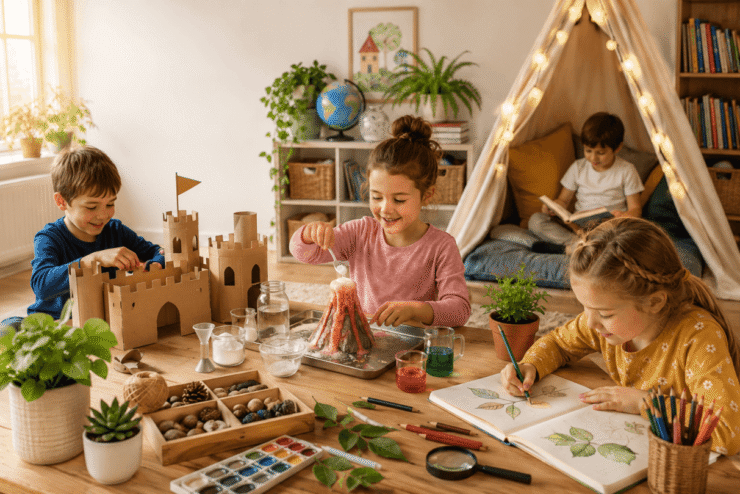
If you’re a parent desperately hunting for screen-free activities for kids at home, you are absolutely not alone. Whether it’s a rainy Saturday, a long school holiday, or just one of those days where the television feels like the easy option, finding ways to keep children busy — and genuinely learning — without a screen in sight can feel like its own full-time job. The good news? You probably already have everything you need. These ten screen-free indoor activities for kids are practical, affordable, and — here’s the part that might surprise you — the children actually want to do them.
I’ve tried every single one of these with my own kids at various ages, and while I won’t pretend there wasn’t the occasional complaint or glitter-related disaster, the results speak for themselves. Less screen time, more creativity, and a whole lot of unexpected learning happening right there at the kitchen table.
1. Kitchen Science Experiments
Science doesn’t need a lab or expensive equipment. Your kitchen is already packed with everything required to run proper little experiments that kids will talk about for days. Baking soda and vinegar volcanoes are the obvious starting point, but once you’ve done that once (or twenty times, if your child is anything like mine), there are so many more to explore.
Try making a lava lamp with water, oil, food colouring and a fizzy tablet. Or grow crystals from salt and warm water overnight. You can even do basic density experiments by layering liquids of different weights in a tall glass. The beauty of kitchen science is that it answers the question children ask constantly: “why?” And because they’re watching it happen in front of them, the answer actually sticks.
For a brilliant collection of easy science activities sorted by age group, the Science Museum Group’s Learning at Home hub has free printable guides and video walkthroughs that make the whole thing far less intimidating for parents who haven’t thought about chemistry since their GCSEs.
2. Build a Cardboard Box World
There is something almost magical about what a child can do with a cardboard box, a roll of tape, and half an hour of uninterrupted time. A delivery box becomes a rocket. A shoebox becomes a dolls’ house. Three boxes taped together become a castle with a working drawbridge (made of more cardboard, naturally).
This is one of those screen-free activities that genuinely sneaks in a huge amount of learning without children even realising it’s happening. They’re problem-solving, planning, measuring (sort of), and using their imaginations in ways that no tablet can replicate. Save your delivery boxes for a week, hand them over with some scissors and a glue stick, and then get out of the way. The less you interfere, the better the result tends to be.
For older children, you can add a challenge element: build the tallest freestanding tower, create a marble run, or design a bridge that can hold a specific weight. Suddenly it’s engineering, and they’re completely hooked.
3. Cooking and Baking Together
Cooking with children is one of those activities that sounds lovely in theory and can feel a little chaotic in practice, but the payoff is genuinely worth the mess. Not only does it teach real-life skills that children will actually use as adults, but it quietly introduces maths (measuring, doubling recipes, fractions), reading (following instructions), and science (what happens when heat meets egg white).
Start simple. Homemade pizza dough is brilliant for little hands because kneading is satisfying and the outcome is delicious. Flapjacks involve weighing and mixing with very few steps. Fruit salad lets younger children practice safe cutting skills with a butter knife. As they get more confident, you can move on to things like homemade pasta or bread — both of which feel impressive and are far easier than they look.
Also Read: Select Creative Tips to Inspire Your Child’s Imagination Through Play
The added bonus? Children who cook their food are statistically far more likely to actually eat it. Worth remembering on the nights when dinner is met with the usual level of enthusiasm.
4. Start a Nature Journal
Nature journalling is having a well-deserved moment right now, and for good reason. All you need is a notebook and a pencil, and the activity scales beautifully from age three right through to teenagers (who may initially need some convincing but usually come around).
The idea is simple: go outside, observe something, and draw or write about it. A leaf. A spider’s web. The birds that visit your garden. A cloud formation that looks like a rabbit. There are no rules about what goes in the journal, and that’s precisely the point. Children learn to slow down, look closely at the world around them, and develop the kind of observational skills that underpin both science and art.
If you want to extend this activity indoors on days when going outside isn’t an option, window-watching works just as well. What birds visit the garden? What does the sky look like at different times of day? The RSPB’s dedicated section for children has downloadable identification charts and spotter sheets that make this even more engaging, particularly for children who like to tick things off a list.
5. Create a Home Library and Reading Nook
Reading is, without question, one of the most powerful screen-free activities you can encourage in children. But there’s a difference between telling a child to “go and read” and actually creating an environment where they want to do it. The latter requires a little bit of effort and a lot less expense than you might think.
Clear a corner, throw some cushions on the floor, hang a little string of fairy lights if you have them, and suddenly you’ve created a reading nook that feels special. Let children choose their own books — even if those books are not what you would choose for them. A child who reads comic books or fact books about dinosaurs is still a child who reads.
You can extend this into a home library project by letting children organise and catalogue the books themselves, create little review cards for their favourites, or even run a family book club where everyone reads the same book and discusses it over dinner. Older children often love the responsibility of being in charge of the ‘lending system.’
6. Play Board Games and Card Games
Board games get a slightly unfair reputation for being the thing you pull out when the Wi-Fi goes down, but honestly, some of the best family afternoons I’ve ever had have involved a battered Scrabble board and far too many arguments about whether a word is real. Games are a brilliant vehicle for learning that doesn’t feel like learning.
Younger children benefit enormously from games that build number recognition, turn-taking, and memory — think Snakes and Ladders, Pairs, or Dobble. As children get older, strategy games like Cluedo, Settlers of Catan (the junior version works brilliantly), or even chess introduce logical thinking and forward planning in a way that is genuinely enjoyable.
Card games are particularly underrated. A simple deck of playing cards opens up an enormous range of games: Snap, Go Fish, Rummy, and eventually poker for older teenagers who think it’s incredibly grown-up to play with real chips. You can also introduce maths card games where children have to add, subtract or multiply the values on the cards they draw.
7. Start a Garden — Even Indoors
Gardening is one of those activities that sounds more effort than it is, particularly if you don’t have outdoor space. But you genuinely do not need a garden to grow things with children. A windowsill, a few pots, some compost, and a packet of seeds is entirely sufficient, and the learning that comes from watching something grow from nothing is unlike anything else.
Cress is the classic starter because it grows within days — fast enough to hold a young child’s attention. Sunflowers are brilliant for older children because they grow tall enough to measure and chart over weeks. Tomatoes and herbs like basil or mint give children the satisfaction of growing something they can actually eat or use.
This activity works well alongside the nature journal mentioned earlier. Children can track the growth of their plants, sketch them at different stages, and record what conditions they were grown in. Without realising it, they’re conducting a proper scientific experiment.
8. Write and Illustrate a Story Book
Every child has stories inside them. The challenge is giving them a format that makes those stories feel worth telling. Making a proper little book — stapled or folded pages, a cover, a title, even an ‘about the author’ page on the back — transforms a writing exercise into something that feels like a real creative project.
Younger children can dictate their story while you write it down, then illustrate the pages themselves. Older children can write and illustrate independently. You can set a theme or let them choose entirely. The end result is something they’ll want to keep and show people — which is a far more meaningful outcome than a worksheet.
For children who are reluctant writers, try starting with a wordless picture book instead. They draw the story panel by panel, like a comic, and then ‘read’ it aloud to you. It builds storytelling confidence without the pressure of spelling and grammar getting in the way.
9. Learn a Practical Skill: Sewing, Knitting or Woodwork
Practical skills have slipped off the curriculum in a lot of schools, which makes them feel almost novel to children when they’re introduced at home. Basic sewing, simple knitting, or even beginner woodwork projects are enormously engaging for children from around age six upwards, and the sense of achievement when they’ve made something with their hands is something that sticks with them.
Sewing is the most accessible starting point: a blunt needle, some felt, and a bit of embroidery thread is all you need. Children can make simple felt animals, bookmarks, or even little bags. Knitting finger puppets is achievable for most children from around age seven. For woodwork, a simple birdhouse kit or a pre-cut wooden box to decorate gives structure without requiring power tools.
Beyond the craft itself, these activities build fine motor skills, patience, and concentration in ways that transfer directly to academic learning. And the pride on a child’s face when they show someone something they’ve made with their own hands is, frankly, hard to beat.
10. Set Up a Post Office or Shop at Home
Role-play activities are, at their heart, incredibly sophisticated learning tools. When a child sets up a pretend shop and starts pricing items, giving change, and managing their ‘stock,’ they are doing genuine maths. When they run a post office and write addresses on envelopes, sort letters and work out delivery routes, they are reading, writing, and spatial reasoning all at once.
The setup takes a few minutes and the children do most of the work themselves. An old cardboard box becomes a till or a post box. A notebook becomes the order book. Coins from a piggy bank become the currency. You can make it as simple or as elaborate as they want.
For slightly older children, you can introduce more complexity: stock management, profit and loss calculations, or even a customer loyalty card system. At that point, you are teaching basic business and financial literacy in the most natural, enjoyable way imaginable. MoneyHelper’s guide on teaching children about money has some great ideas for weaving financial awareness into everyday play, which pairs beautifully with this kind of activity.
A Few Things Worth Remembering
Before you launch into any of these, a couple of honest notes from someone who has done this many times:
- Not every activity will land with every child. That’s absolutely fine. Try it, move on if it isn’t working, and try something else. Children’s interests shift constantly, and what fails at five might be their favourite thing at seven.
- Resist the urge to hover. The best learning happens when children are slightly unsure what to do next and have to figure it out. Your job is to set up the activity, step back, and be available if they genuinely need you.
- Mess is part of it. Accept this early and you will enjoy all of these activities far more than if you spend them worrying about the floor.
- Children often need a transition period when screens are switched off. A bit of moaning, a bit of ‘I don’t know what to do.’ Give it ten minutes. Once they’re absorbed in something, they generally forget all about whatever they were watching.
Conclusion
The truth is, children don’t need screens to be entertained. They need ideas, a little bit of space, and a parent who occasionally gets on the floor and joins in. The activities above aren’t about creating perfect, Pinterest-worthy moments — they’re about filling an afternoon with something that leaves children feeling capable, curious, and a little bit proud of themselves.
Also Read: Some of My Favourite Games From Childhood
Some days it will go brilliantly. Some days someone will knock over the vinegar experiment or declare that sewing is ‘boring’ after three minutes. That’s parenting. But the days when it clicks — when you look over and see your child completely absorbed in building something or writing a story or carefully tending their cress seedlings — those are the moments that make all the glitter worth vacuuming up.
Give a few of these a try and see which ones work for your family. There’s something on this list for every age, every temperament, and every level of parental energy — including the days when yours is running on fumes.