Quick Answer: A genuinely effective 20-minute home workout with no equipment combines bodyweight strength moves (squats, push-ups, lunges) with short bursts of higher-intensity cardio, structured as circuits with minimal rest. The NHS confirms strength exercises count toward weekly activity guidelines as long as they’re performed to the point where another rep would be difficult without help.
Twenty minutes sounds too short to matter, until you actually structure it properly, which is exactly what makes a 20-minute home workout no equipment approach so useful for anyone who keeps skipping exercise because a full gym session feels like too much to fit in. The NHS confirms that muscle-strengthening exercises should be performed until another repetition becomes difficult without help, not for a specific duration, which means twenty focused minutes of bodyweight training genuinely counts as meaningful exercise, not just a token gesture.
The 20-Minute Structure at a Glance
| Block | Duration | What It Covers |
|---|---|---|
| Warm-up | 3 minutes | Dynamic movement, raise heart rate, mobilise joints |
| Circuit 1 (lower body) | 5 minutes | Squats, lunges, glute bridges |
| Circuit 2 (upper body) | 5 minutes | Push-ups, tricep dips, plank shoulder taps |
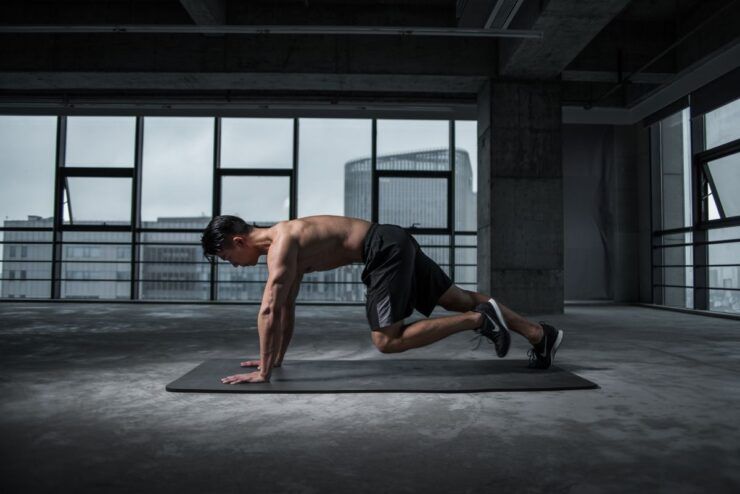
| Circuit 3 (core and cardio) | 5 minutes | Mountain climbers, bicycle crunches, high knees |
| Cool-down | 2 minutes | Static stretching, breathing, heart rate recovery |
A simple, repeatable structure; exact exercises can rotate to avoid boredom and target different muscle groups.
Why This Structure Actually Works
Alternating between lower body, upper body, and core-cardio blocks means no single muscle group is working continuously, which allows you to keep moving at a genuinely challenging intensity for the full twenty minutes rather than needing long rest periods between sets. This circuit approach also naturally covers the NHS recommendation to work all major muscle groups, legs, hips, back, abdomen, chest, shoulders, and arms, within a single short session.
This structure also has a practical psychological benefit worth mentioning: knowing a specific muscle group’s block is only five minutes away from switching makes the whole twenty minutes feel considerably more manageable than an undifferentiated block of continuous exercise, which matters more than it sounds for anyone still building the mental habit of sticking with a workout to the end.
Getting the Warm-Up Right
Skipping the warm-up to save time is one of the most common mistakes in a short home workout, and it’s counterproductive; cold muscles perform worse and are more prone to strain, which risks losing training days to injury rather than saving a few minutes now. Dynamic movements, leg swings, arm circles, bodyweight squats at a slow pace, raise core temperature and prepare joints far better than static stretching before exercise.
A genuinely effective three-minute warm-up doesn’t need to be complicated: thirty seconds each of marching on the spot, arm circles, bodyweight squats, leg swings per side, and torso twists covers the major joints and muscle groups you’re about to use, raising heart rate gradually rather than jumping straight into high-intensity work from a cold start.
Making Bodyweight Exercises Genuinely Challenging
A bodyweight workout doesn’t have to be gentle just because there’s no equipment involved. Slowing down the lowering phase of a squat or push-up, adding a pause at the hardest point of the movement, or reducing rest between rounds all increase difficulty substantially without needing a single dumbbell. For anyone who’s outgrown a basic bodyweight routine, single-leg variations (pistol squat progressions, single-leg glute bridges) add considerable challenge using body weight alone.
Tempo manipulation deserves particular attention since it’s the most underused tool in home workouts: a squat performed with a three-second lowering phase, a one-second pause at the bottom, and an explosive rise recruits considerably more muscle fibre than the same squat done at a constant, moderate speed, despite looking nearly identical from the outside.
Common Form Mistakes Worth Correcting Early
Knees collapsing inward during squats, hips sagging during a plank, and shoulders creeping up toward the ears during push-ups are three of the most common form issues in bodyweight training, and all three are considerably easier to correct early than after months of practising the same compensation pattern. Recording a short video of yourself performing each exercise, even just on a phone propped against a wall, catches these issues far more reliably than trying to self-assess in the moment.
It’s worth reviewing this footage against a simple checklist rather than a vague overall impression: are knees tracking in line with toes, is the back flat rather than arched or rounded, are shoulders staying down and away from the ears. Checking one specific cue at a time, rather than trying to assess everything simultaneously, makes the review considerably more useful for actually catching and correcting the issue.
Scaling the Workout to Your Current Fitness Level
Every exercise in a bodyweight circuit has an easier and harder version available without changing the overall structure. Push-ups can be performed from the knees rather than toes, squats can use a chair for support and depth guidance, and high-impact cardio moves like burpees can be replaced with a slower, low-impact step-back version that still elevates heart rate without the joint stress.
A genuinely useful mindset shift here: scaling an exercise down isn’t a lesser version of the workout, it’s the correct version for your current stage, in the same way a beginner runner doesn’t attempt a marathon pace on day one. Choosing the appropriately scaled variation and performing it with full control and good form produces more actual strength benefit than attempting a harder variation with compromised technique.
Fitting This Into an Actual Busy Week
The realistic advantage of a twenty-minute no-equipment workout isn’t the exercises themselves, it’s that there’s no excuse of gym travel time, equipment setup, or specific clothing required. A session done in a living room before work, or during a lunch break at home, removes nearly every common barrier that causes longer workouts to get skipped entirely on a busy day.
This matters more than it might seem, since research on exercise adherence consistently identifies logistical friction, travel time, changing clothes, packing a gym bag, as a bigger barrier to consistency than motivation itself for a large share of people. Removing every one of those friction points by exercising at home in whatever you’re already wearing genuinely changes the odds of a session actually happening on a day when motivation alone might not be enough.
It’s also worth having a backup, even shorter version ready for the days when even twenty minutes feels impossible: a single round of the core circuit, roughly seven minutes, is far better than skipping entirely, and keeps the habit alive through a genuinely difficult week rather than breaking the pattern altogether.
Tracking Progress Without a Gym’s Equipment
Without weights to increase, progress in a bodyweight programme is measured differently: more repetitions in the same time, a harder variation of the same exercise, or less rest needed between rounds. Keeping a simple note of which variation you’re using for each exercise, and revisiting it every few weeks, makes progress visible even without a single number on a weight plate to point to.
A useful benchmark test worth repeating monthly: how many good-form push-ups, squats, and plank seconds can you complete in one minute each. Comparing this simple three-number snapshot over a few months tends to be more motivating and honest than trying to remember vague impressions of “feeling stronger” without any actual measurement behind it.
Combining This Workout With Other Movement
A twenty-minute strength-focused circuit pairs naturally with daily walking and occasional flexibility work, together covering the three main pillars of general fitness, strength, cardiovascular activity, and mobility, without needing three separate dedicated sessions each day. On days without a full circuit, even ten minutes of walking or a short stretch sequence keeps general activity levels up without adding decision fatigue about fitting in more.
This combined approach also naturally satisfies both halves of NHS physical activity guidance, the 150 minutes weekly of moderate aerobic activity and the twice-weekly muscle-strengthening recommendation, without needing to think about them as two entirely separate obligations competing for the same limited time each week.
Key Takeaways
- Structure the 20 minutes as circuits (lower body, upper body, core-cardio) rather than one continuous exercise type.
- Always include a 2–3 minute dynamic warm-up; skipping it increases injury risk more than it saves time.
- Increase difficulty through tempo, pauses, and single-leg variations rather than needing equipment.
- Scale any exercise up or down (knee push-ups, chair-assisted squats) to match your current fitness level.
- Track progress through reps, variation difficulty, and rest time, since there’s no weight number to reference.
Conclusion
Twenty minutes, done properly and consistently, genuinely moves the needle more than an occasional hour-long session that keeps getting skipped. If you’re still working out how to make this a lasting habit rather than a one-off, our guide to building a fitness routine you’ll actually stick to covers exactly that.
And if mornings are when you’re most likely to fit this in, pairing it with our 7 stretches to do every morning as a warm-up or cool-down is a natural combination.
Either way, the specific exercises matter far less than actually showing up consistently; a genuinely modest twenty-minute session done four times a week for a year outperforms an ambitious hour-long routine attempted for three weeks and then abandoned entirely.
Frequently Asked Questions
Can a 20-minute bodyweight workout really build noticeable strength?
Yes, provided it’s performed to the point where another repetition would be difficult, which is the same standard the NHS applies to any muscle-strengthening activity, regardless of session length or equipment used.
How many days a week should I do this kind of workout?
NHS guidelines recommend muscle-strengthening activity covering all major muscle groups at least twice a week, so three to four sessions is a reasonable target for steady, noticeable progress.
Do I need any equipment at all for this to be effective?
No; bodyweight alone can provide sufficient resistance for most beginners and intermediate exercisers when tempo, pause, and single-leg variations are used to increase difficulty as you progress.
Is a 20-minute workout enough if I’m trying to lose weight?
It contributes meaningfully alongside overall daily activity and diet, though weight management typically also benefits from additional daily movement like walking, since a single short session alone rarely creates enough of a calorie deficit on its own.
What should I do if a specific exercise hurts a joint?
Switch to a lower-impact variation immediately (a step-back instead of a jump, a wall push-up instead of a floor push-up) and consult a GP or physiotherapist if pain persists beyond normal muscle fatigue.